
Heat Pump Not Heating
If your heat pump isn't heating or isn't delivering the expected heat output, the cause could be simple — such as dirty filters — or technical, such as a lack of refrigerant or a compressor fault. This page covers the most common reasons and a clear sequence of steps to try before calling a specialist.
A heat pump problem is one of the most stressful moments in the middle of winter — the home cools down, the electricity or fuel bill rises, and the feeling that nothing is working is overwhelming. In practice, though, most cases of a heat pump not heating stem from simple, checkable causes, and only some require technical intervention. Starting with what you can check yourself saves time and avoids an unnecessary repair callout.
Why the heat pump isn't heating
First, it's important to understand that "heat pump not heating" can mean two different situations. The first — the unit doesn't work at all, doesn't turn on, shows an error code, or is silent. The second — the unit is running, the compressor is spinning and the fans are turning, but the home still stays cold. The second case is often more misleading, because everything seems fine, yet the capacity isn't sufficient.
The causes behind these situations differ. Complete failure to operate is most often linked to the power supply, control board, sensors, or a triggered safety cutoff. Reduced capacity is linked to airflow disruptions, refrigerant quantity, heat exchanger contamination, or hydraulic system imbalance.
Before jumping to a conclusion between a unit fault and the heating system's layout, it's strongly recommended to first check the simplest points — they take minutes and often resolve the problem without a repair.
Simple causes you can check yourself
Most heat pump manufacturers recommend starting with the same checklist. Here are the main points you can go through before calling a specialist.
- Dirty air filters. Indoor unit filters accumulate dust and hair within about a couple of months. Reduced airflow lowers heat output and can trigger a safety shutoff.
- Outdoor unit obstructed. Leaves, snowdrifts, ice or plants within 30 cm of the outdoor unit block airflow. Clear the surrounding area so air can flow freely in and out.
- Thermostat settings. Check whether the thermostat is set to heating mode, whether the desired temperature is higher than the current one, and whether there isn't an active schedule lowering the temperature.
- Power supply. Check whether a circuit breaker or residual current device near the heat pump has tripped. Sometimes a simple restart is enough — turn it off for 5 minutes and turn it back on.
- Valves and heat-emitting devices. Confirm that radiator or underfloor heating valves are open and circulation in the system hasn't stopped.
Technical causes
If a simple check doesn't help, the possible technical causes become more serious and usually require professional diagnostics with pressure, resistance and error code measurements.
- Low refrigerant level. As a result of a leak, the amount of refrigerant reduces the unit's capacity. The unit may run, but heat much less. Finding the leak and topping up the refrigerant must only be done by a certified F-gas specialist.
- Compressor fault. A mechanical or electrical compressor failure usually causes complete non-operation or an error code related to overload.
- Defrost system malfunction. At low outdoor temperatures, the outdoor unit ices up. The defrost cycle automatically thaws it. If the sensor or reversing valve doesn't work, the unit doesn't defrost and capacity drops sharply.
- Sensor faults. Temperature, pressure or outdoor-end sensors can send incorrect data to the control board, causing the unit to run in a reduced mode or stop functioning altogether.
- Circulation pump failure (air-to-water and ground-source systems). If the pump doesn't circulate the heating water, heat isn't delivered to the rooms, even though the unit itself is running.
- Stuck three-way valve. The valve that switches between heating and hot water preparation can get stuck in one position, causing the home to stay cold while the boiler is being heated.
- Expansion tank problems. Low pressure in the hydraulic system or a defective expansion tank can trigger a safety shutoff.
Freezing outdoor unit
A very common situation in Latvian winters is ice buildup on the outdoor unit's coil. This is a normal process at low outdoor temperatures and high humidity — the heat pump works by cooling the outdoor air, and moisture condenses on the cold coil, turning to ice in the cold.
Modern heat pumps solve this automatically with a defrost cycle: the unit briefly reverses, warming the outdoor unit and melting the ice. If the ice doesn't melt or accumulates heavily, the cause is most often incorrect defrost sensor operation, a control fault, or a damaged reversing valve. A defrost mechanism failure is one of the most typical reasons why a heat pump doesn't heat in the middle of winter.
What to do if the heat pump isn't heating
If the problem isn't obvious and simple checks don't help, follow this sequence:
Filters
Clean the indoor unit's filters. If they haven't been cleaned in over a month, this is the first source of heat loss.
Outdoor unit
Check whether the outdoor unit is obstructed, whether the surrounding area is clear, and whether ice hasn't covered the coil.
Thermostat and valves
Check the thermostat settings and radiator or underfloor heating valves. Confirm there is circulation in the system.
Error code
If the unit shows an error code, note it down. See the error code list to understand what the code means.
Request a repair
If you've gone through all the steps and the problem persists, submit a request below — we will contact you for your region and system type.
When to call a specialist
Some situations require immediate intervention by a professional technician rather than DIY troubleshooting. These are warning signs when it's better not to delay:
- An error code returns after a restart or doesn't clear at all.
- The unit makes clicking, knocking or other unusual sounds not heard before.
- Ice on the outdoor unit doesn't melt even after hours of operation.
- The home keeps cooling down even though the filters are clean and the outdoor unit is clear — possibly a refrigerant leak or compressor fault.
- The heating system's pressure gauge reads below the expected value or has changed suddenly.
In these cases, don't delay — request a repair, stating the manufacturer, model and error code, if any. The specialist will be able to prepare for diagnostics and carry out the repair faster. We will contact you to clarify details and provide a quote. — this is the only transfer of information that occurs when you submit a request through this platform.
How does the service work?
- ✓Free request
- ✓Our specialist in your region
- ✓Diagnostics and repair
- ✓Your data is safe with us
Important before submitting
Note the heat pump's manufacturer, model and, if displayed, the error code. This helps the technician prepare and diagnose faster. If you don't know — don't worry, you can clarify after being contacted.
Request a repair
Fill in the form — we'll be in touch within 5 minutes!
Frequently asked questions
See also
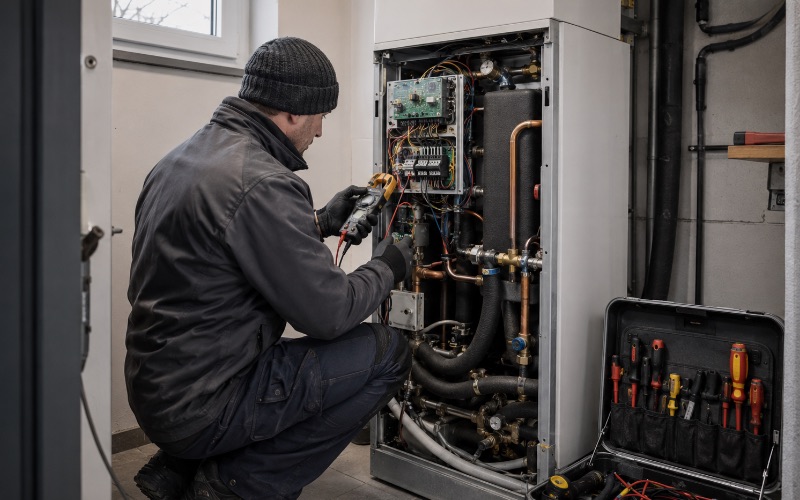
Heat pump repair
Diagnostics and repair across Latvia. Request a repair and get matched with a suitable specialist.
Heat pump error codes
The most common error codes and their meaning. Learn what a code means and what to do.
Heat pump maintenance
Preventive upkeep that prevents breakdowns and keeps the manufacturer's warranty valid.
Heat pump not heating?
Request a repair — we'll be in touch within 5 minutes!