
Heat Pump for an Apartment
A heat pump for an apartment is a realistic and effective solution — an air-to-air system heats and cools air directly in the rooms without water pipes or hydraulic work. Installation is quick and clean, usually within a single day.
A heat pump for an apartment is becoming an increasingly popular solution in Latvian apartment buildings, where owners want to reduce heating costs or move away from district heating. Unlike private houses, the choice of systems available for apartments is limited — the only realistic option is an air-to-air heat pump. This page covers why that is, how the system works, what it costs, and what you should know before installation.
Air-to-air — the only realistic option for apartments
Apartments usually don't have an individual water-based heating system that could be added to or modified. District heating or an individual boiler requires water pipes, and the pipes in an apartment are usually part of the building's shared floor system, which can't be freely rebuilt. For this reason, air-to-water and ground-source heat pumps, which need to heat water, aren't suitable for apartments.
An air-to-air heat pump heats and cools air directly in the rooms, using one outdoor unit and one or more indoor units. There are no water pipes, no leak risk, no hydraulic work, and no need to wait for the building's shared system to be shut off. It's the only heat pump type that can be installed in an apartment without significant interference with the building's structure.
That's why, when talking about a heat pump for an apartment, what's actually meant is almost always an air-to-air heat pump — and all the following sections relate to this specific system.
How it works in an apartment
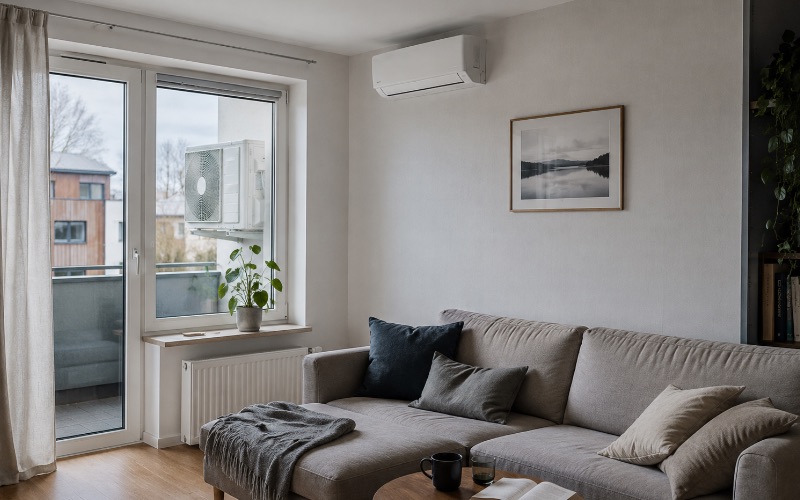
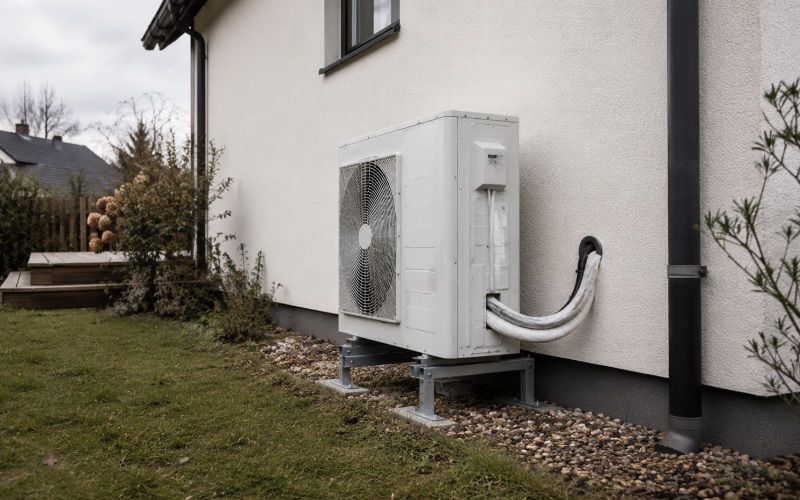
The system consists of two main parts — an outdoor unit and an indoor unit. The outdoor unit is placed on a balcony, facade or a special bracket that ensures free airflow and compliance with noise standards. The indoor unit is mounted on the wall in the required room — usually the living room or hallway, which ensures even heat distribution throughout the apartment.
Both units are connected with a refrigerant pipe that is routed through the wall — usually through a small hole 60–80 mm in diameter. This is the only work that requires drilling. The rest of the installation is clean and mess-free — mounting the units, connecting the pipe and connecting the electricity.
It works like an air conditioner that also heats — which is why many call it a "heater and cooler in one." Modern units maintain high efficiency even down to –15°C or –20°C outdoor temperature, so in Latvia's winter conditions they're sufficient for most of the season. On very cold days, additional heat may be needed, but on average a heat pump for an apartment significantly reduces overall heating costs.
Installation in an apartment
One of the biggest advantages of an air-to-air heat pump for an apartment is quick, clean installation. In most cases the whole process takes a single day, with no hydraulic work, pipe replacement or mess. This matters in apartments where larger renovation work isn't possible or desirable.
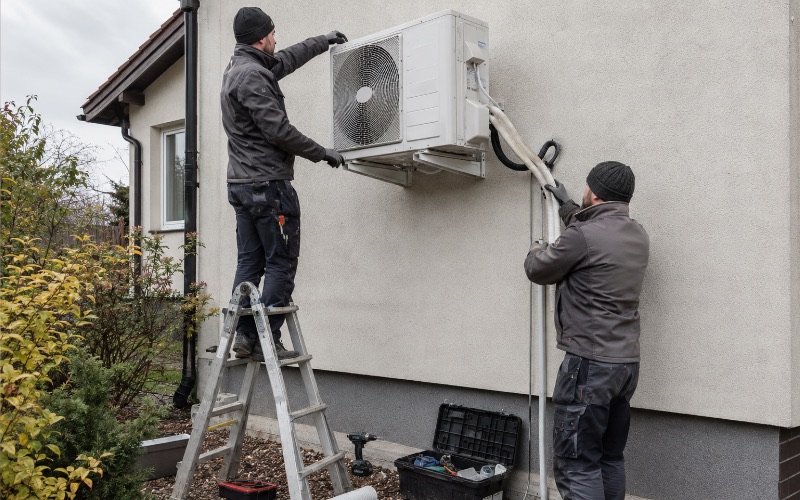
The main installation stages are: mounting the outdoor unit on a bracket on the facade or balcony, drilling a hole in the wall for the outdoor connection, mounting the indoor unit on the wall, connecting pipes and cables, and starting up the unit with control settings. Afterward you receive usage documentation and instructions.
Unlike an air-to-water system, which requires a buffer tank and hydraulic work, air-to-air heat pump installation in an apartment requires minimal technical preparation. The only things to check before installation are whether the apartment has sufficient electrical capacity and whether the wall allows a hole to be drilled for the outdoor connection.
Approval from the building management
Before installing a heat pump in an apartment, it's advisable to get approval from the homeowners' cooperative or building management. This especially applies to the outdoor unit's placement — on the facade it may alter the building's exterior appearance, and different buildings have different rules about facade changes.
Some building managements require a written request and a project description before installation; others only allow the outdoor unit on the balcony or in specially designated spots. There are also buildings where the outdoor unit must be placed on the roof or a shared wall — in that case approval is mandatory.
The specialist carrying out the installation usually helps prepare the necessary documents and description for the building management. This significantly eases the approval process and reduces errors or gaps in documentation.
Noise and condensation
One of the most common concerns about a heat pump in an apartment is noise — both from the indoor and outdoor units. Modern units are significantly quieter than older-generation air conditioners. A typical indoor unit operates at a 20–35 dB sound level, similar to a quiet fan or refrigerator. The outdoor unit is louder, but it's located outside the apartment, and with a proper bracket and vibration base, noise inside the apartment is minimal.
Condensation occurs in cooling mode in summer, when the unit cools the air and moisture separates from it. It's drained through a thin pipe outside — usually to a drainpipe, the balcony floor or a special collection tank. The condensation drainage route should be planned already during installation, so no additional work is needed later.
In heating mode, condensation forms on the outdoor unit, which can cause icing or freezing below zero. Modern units automatically run defrost cycles that prevent icing, but the outdoor unit must be positioned so the defrost water doesn't endanger balconies or windows below.
Prices for an apartment
A heat pump for an apartment is the lowest price tier of all heat pump types. Indicatively, installation with the unit costs from €1,500 to €5,000, depending on the unit's capacity, the number of indoor units and installation complexity. A simpler option with one indoor unit for a typical 40–60 m² apartment costs around €1,500–€2,500, while larger apartments with multiple units can reach €4,000–€5,000.
Because of this low price tier, an air-to-air heat pump for an apartment pays back faster than other systems — a typical payback period is 4–7 years, depending on the previous heating type and tariffs. Read more about price factors and different options on the heat pump installation price page.
After you submit the form, we will contact you for your region. and apartment installations. We will contact you to clarify details, the most suitable unit capacity and, if needed, arrange a site visit at your apartment. The request is free and non-binding.
How does the service work?
- ✓Free request
- ✓Our specialist in your region
- ✓Price quote after a site visit
- ✓Your data is safe with us
Frequently asked questions
See also
Air-to-air heat pump installation
The main system for apartments and homes without water-based heating — heating and cooling.
Heat pump installation price
Detailed cost factors and indicative prices for different heat pump systems.
Air-to-water heat pump installation
Suited to homes with water-based heating — heats water for radiators and underfloor heating.
Heat pump for an apartment — interested?
Free request — we'll be in touch within 5 minutes!