
Heat Pump for an Old House
Heat pump installation for an old house requires more careful preparation — it's important to assess insulation, radiator suitability and, if necessary, consider a hybrid system. Get advice and a price quote from our specialist in your region.
A heat pump for an old house is a worthwhile solution, but it requires more careful preparation than for a new build. Older houses typically have higher heat losses, fewer layers of insulation, and existing radiator systems that aren't always suited to low supply temperatures. This page covers the key questions to consider before installing a heat pump in an old house — from insulation to hybrid systems.
Insulation — the most important factor
Older houses typically have a higher level of heat loss — thinner wall insulation, older windows and door seals, and less effective roof or floor insulation. This means the heat pump will need a larger capacity, which raises both purchase and operating costs. That's why, before choosing a heat pump, it's important to assess the building's insulation and improve it if necessary.
Typical improvements that significantly reduce heat loss: an additional insulation layer on the facade (expanded polystyrene or mineral wool boards), replacing windows with double- or triple-glazed units, replacing door seals, and adding roof or floor insulation. These works are best carried out before heat pump installation, since after installation the unit's capacity can no longer be adjusted without significant cost.
Radiator suitability
Alongside insulation, it's important to assess the existing radiators. Heat pumps operate at lower supply temperatures — usually 35–55°C — unlike traditional gas or wood boilers, which heat water up to 70–80°C. The lower temperature means existing radiators may not be able to release enough heat, as their radiating surface was designed for a higher temperature.
As a result, larger radiators or additional heat-emitting surfaces may be needed. In some cases, underfloor heating can help alongside existing radiators, increasing the heat-emitting surface and improving comfort. Read more about this on the heat pump with radiators page.
Cast-iron radiators are usually well suited for use with a heat pump due to their high water volume — they hold a lot of water, which ensures even heat distribution even at a lower supply temperature. Modern steel panel radiators may be undersized if designed for a higher temperature.
Air-to-water or air-to-air
For most old houses with an existing radiator system, an air-to-water heat pump is the best choice, as it integrates with the existing water-based heating system without needing to replace it entirely. It heats water for radiators and underfloor heating, as well as providing hot water for domestic use. It's also suited to homes with an existing boiler room and a spot for a buffer tank.
For homes without water-based heating, or where the existing pipe system is too old or damaged, an air-to-air heat pump may be a simpler solution. It heats air directly in the rooms without needing to rebuild the water system. It can also serve as supplementary heating while the existing heating system is being renovated or replaced.
The choice between these two types depends on the condition of the existing system, budget and the home's layout. During the site visit, a specialist will help assess whether the existing radiator system can be used, or whether it's better to replace it or add an air-to-air system without hydraulic work.
Hybrid systems
Another option for old houses with high heat losses is a hybrid system — a heat pump combined with a backup heater, usually a gas or pellet boiler. This solution is suited to homes where the existing boiler still works, but the owner wants to reduce heating costs by using the heat pump as the primary heat source.
A hybrid system's operating principle is simple: the heat pump works for most of the season, when outdoor temperature is above –5°C to –10°C. When outdoor temperature drops below this threshold and the heat pump's efficiency decreases, the system automatically switches on the backup boiler, which provides the necessary heat on very cold days. Switching happens automatically, using a smart control unit that chooses the most cost-effective heat source for the given conditions.
This solution is especially useful for homes that can't fully switch to a heat pump — for example, if insulation is poor and the heat pump's capacity alone isn't enough on the coldest days. A hybrid system provides a compromise between energy efficiency and reliability, reducing overall heating costs while keeping a backup heat source.
Measuring heat loss
Before installing a heat pump in an old house, measuring heat loss is essential — a thermographic survey and an energy audit. A thermographic survey with a thermal camera reveals areas of heat loss — through walls, windows, roof or floor zones — that aren't always visible without an instrument. It helps identify which building elements need attention before heat pump installation.
An energy audit is an in-depth assessment of the building that includes heat-loss calculations, an insulation assessment and recommendations for improving energy efficiency. It provides a numerical basis for calculating the heat pump's capacity and helps avoid choosing a unit that's too large or too small. After the survey, the specialist determines actual heat losses and recommends the most suitable heat pump type and capacity.
This information is essential to avoid a situation where a heat pump is installed but can't heat the home on the coldest days or, conversely, is too large and runs inefficiently in short cycles.
The installation process for an old house
Heat pump installation for an old house begins with a thorough site visit, which is a critical stage — considerably more detailed than for a new build. The specialist assesses not only the building but also the existing heating system, electrical wiring and possible locations for a buffer tank.
During the site visit, several additional works may be identified as necessary before the heat pump installation itself: improving insulation in wall or roof areas, assessing radiators and, if needed, replacing or supplementing them, checking the electrical connection and, if needed, increasing capacity, and planning the buffer tank's placement in the technical room.
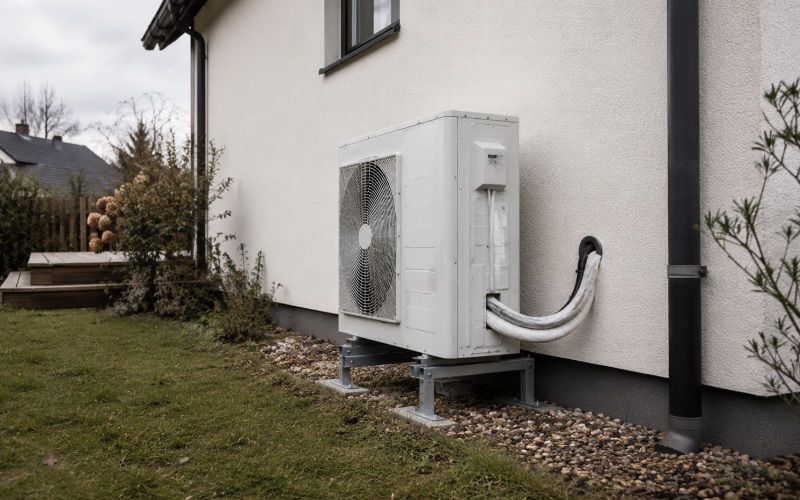
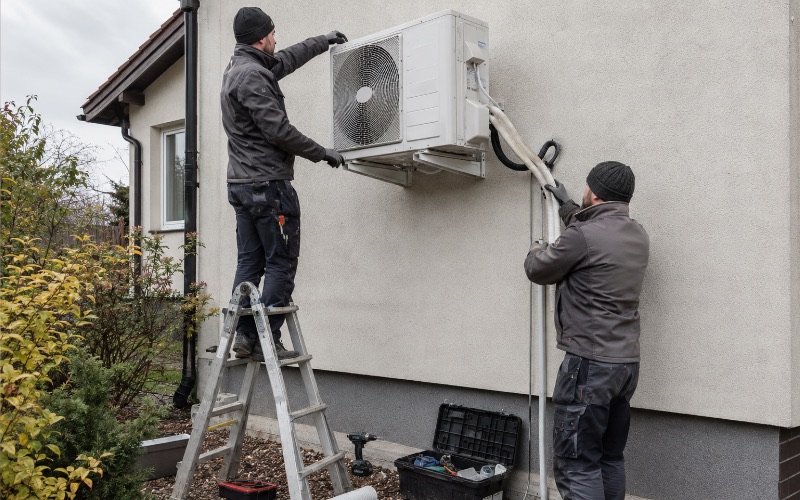
After the site visit and project planning, the installation itself begins — mounting the outdoor unit with a vibration base, installing the indoor unit or hydraulic group, installing the buffer tank and hot water cylinder, connecting pipes and electrical wiring, and starting up the system with optimal heating curves. Read more about the whole process on the main heat pump installation page.
After you submit the form, we will contact you to clarify details and arrange a site visit, during which the building's suitability and possible solutions will be assessed. The request is free and non-binding.
How does the service work?
- ✓Free request
- ✓Our specialist in your region
- ✓Price quote after a site visit
- ✓Your data is safe with us
Frequently asked questions
See also
Air-to-water heat pump installation
Suited to homes with an existing radiator system — integrates with existing water-based heating.
Heat pump with radiators
How a heat pump works with existing radiators and what to know before installation.
Heat pump installation price
Detailed cost factors and indicative prices for different heat pump systems.
Heat pump for an old house — get advice
Free request — we'll be in touch within 5 minutes!