
Heat Pump for a New Build
Plan a heat pump for a new home already in the design phase — an optimal technical room, underfloor heating and an air-to-water system without later rebuilding. Get a price quote from our specialist in your region.
A heat pump for a new build is the most effective path to a low heating bill and high comfort. If heat pump installation for a new home is planned already in the design phase, every stage can be optimized — from insulation to pipe layout for underfloor heating. This page covers what to know about a heat pump in a new build and how to avoid the most common mistakes.
Planning from the start
The best time to plan a heat pump for a new build is during the home's design phase — before walls are built and floor slabs poured. Heat pump installation for a new home in this case doesn't involve retrofit costs: there's no need to replace existing pipes, rebuild the technical room, or increase electrical capacity. Everything is included in a single, unified system design.
The design can optimize insulation thickness, window area and orientation so that heat losses are as small as possible. The smaller the heat losses, the smaller the capacity needed for the heat pump — and a smaller capacity means both lower purchase and operating costs. A heat pump for a new build, planned together with the building's design, usually costs considerably less than later installation in a finished home.
Underfloor heating + air-to-water — an ideal pairing
For a new build, underfloor heating and an air-to-water heat pump form an ideal pairing. Underfloor heating operates at low supply temperatures (28–35°C), which is exactly at the heat pump's efficiency optimum. Lower supply temperature = higher SCOP = lower electricity consumption. Read more about this combination on the heat pump with underfloor heating page.
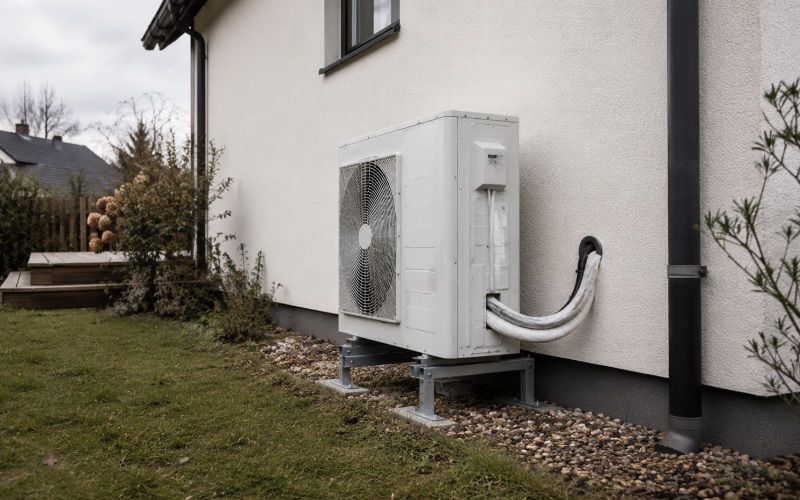
A new build is also the most cost-effective time to install an air-to-water heat pump, since underfloor heating pipes can be laid in the slab layer together with the floor construction. There's no additional work or floor covering removal. Read about the system itself on the air-to-water heat pump installation page — it covers monobloc versus split, costs and the process in detail.
Correct capacity selection
One of the most common mistakes in heat pump installation for a new home is choosing too large a capacity. Since a new build meets modern insulation requirements, its heat losses are considerably smaller than those of older homes. As a result, the required heat pump capacity is smaller — a typical 150 m² new home often needs only a 5–8 kW unit.
Capacity should be calculated based on the building's energy-efficiency calculation, not on rough rules of thumb or a neighbor's unit parameters. A heat pump that's too large cycles on and off, which reduces efficiency and shortens the compressor's service life. Too small — on the coldest days it can't provide the required comfort. A correctly chosen heat pump for a new build will run smoothly and last a long time.
Buffer tank and hot water
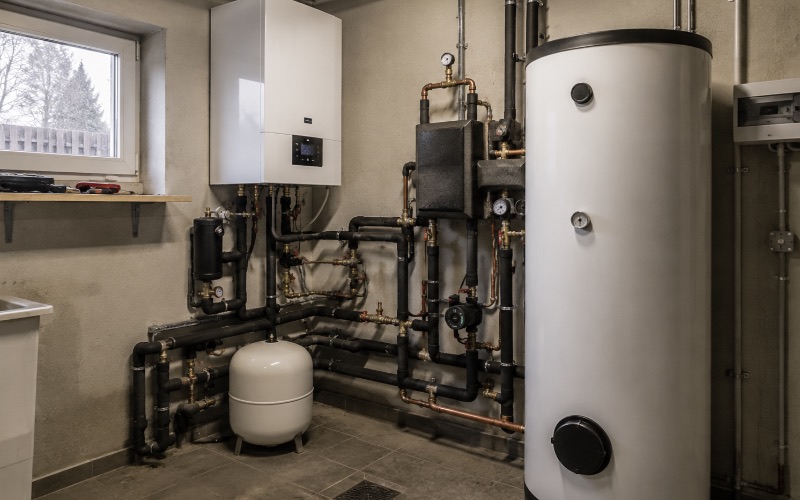
A buffer tank is one of the most important components in an air-to-water heat pump system. It stores hot water and lets the heat pump run in optimal cycles, rather than constantly reacting to every thermostat signal. A new build is the ideal time to include the buffer tank in the technical room's design — allocate space for it already at the drawing stage, so equipment doesn't need to be rearranged later.
Hot water preparation should be planned similarly. A new home usually gets a separate cylinder with a heat exchanger, or a combined buffer tank with an integrated hot-water zone. Correctly sizing the buffer tank and cylinder ensures the system runs efficiently in both heating and hot-water modes — without wasted energy.
Energy-class requirements
Latvian building codes set minimum energy-efficiency requirements for new builds. A heat pump is one of the most effective ways to achieve energy class A or B, which is a requirement for almost all new private homes. Unlike traditional boilers, a heat pump produces more heat than the energy it consumes — a typical SCOP is 3.5–5, depending on the system type.
Integrating the heat pump with the building's energy-efficiency calculation also allows more precise planning of support mechanisms and, if applicable, submission for a compliance check. A specialist will help align the unit's specification with requirements and ensure the system meets both building codes and the manufacturer's warranty conditions.
Integration with ventilation
In a new build, a heat pump is best planned together with heat-recovery ventilation (HRV). Heat-recovery ventilation reduces heat losses from air exchange, while the heat pump covers the remaining heat demand. Together, the two systems deliver the lowest operating costs achievable in a new build.
Ventilation duct layout should be planned during the structural design phase — after walls and ceilings are built, positioning them is considerably harder and more expensive. A specialist will assess how the heat pump and HRV system can work together — for example, whether the heat pump can also prepare hot water for a preheating exchanger in the ventilation system.
Overall, a heat pump for a new build is the best long-term solution, as long as it's planned together with the building's design. Submit your request — we will contact you and help you choose the right system for your new home.
How does the service work?
- ✓Free request
- ✓Our specialist in your region
- ✓Price quote after a site visit
- ✓Your data is safe with us
Frequently asked questions
See also
Air-to-water heat pump installation
The most popular solution for new builds with water-based heating and underfloor heating.
Heat pump with underfloor heating
The ideal combination for maximum efficiency — low-temperature heating.
Heat pump installation price
Detailed cost factors and indicative prices for different systems.
Heat pump for a new build — interested?
We'll be in touch within 5 minutes of you submitting the form!