
Heat Pump Repair
Heat pump repair and diagnostics across Latvia. If your unit isn't working, is showing an error code, or isn't heating enough — request a repair, and a specialist will be in touch within 5 minutes.
Heat pump repair is an essential service when the unit stops working properly, or at all. Unlike traditional boilers, a heat pump is a relatively complex device with a compressor, electronic control boards, sensors and a refrigerant circuit — so its repair requires specialized knowledge and diagnostic equipment. This page covers when heat pump repair is needed, what problems typically arise, and how a professional repair process works.
Heat pump repair — when it's needed
Heat pump repair should be requested as soon as you notice the unit isn't performing as expected. The sooner a problem is identified, the cheaper and simpler the repair usually is. There are several typical signs indicating your heat pump needs a technician's attention.
- The heat pump isn't heating or isn't heating enough. The unit runs, but the home doesn't reach the desired temperature — one of the most common reasons homeowners request a repair.
- Increased electricity consumption. If your bills are rising but your usage habits haven't changed, the unit may be operating inefficiently — for example, an auxiliary heater running continuously.
- Unusual sounds. Hissing, knocking, rattling or other unusual sounds point to mechanical problems — compressor, fan or pump damage.
- Error code on the display. Modern heat pumps display error codes that point to a specific problem. You can resolve some yourself; others require a technician.
- Freezing outdoor unit. A little frost buildup is normal, but if ice covers a large part of the unit, there may be a defrost system problem.
- The unit doesn't work at all. This is a clear case — after switching it on, nothing happens, the fan doesn't turn, the compressor doesn't run.
If you notice any of these signs, don't hesitate to request a repair. Continuing to operate the unit with a problem can shorten its lifespan and increase repair costs.
Most common problems
Heat pump repair specialists in Latvia most often encounter several types of problems. While each unit is different, some issues are general and related to the operating principles of heat pumps.
Compressor failure is usually the most expensive repair. The compressor is the heart of the heat pump — it compresses the refrigerant and allows heat transfer. Causes of failure can be electrical, mechanical, or related to insufficient refrigerant. Compressor replacement requires a certified F-gas specialist.
Sensor errors are more common and usually cheaper to fix. Temperature, pressure or flow sensors can provide incorrect readings, causing error codes and improper unit operation. In most cases, sensor replacement is quick and relatively inexpensive.
Frozen outdoor unit — if the defrost system isn't working properly, ice builds up on the heat exchanger, blocks airflow and significantly reduces the unit's efficiency. The cause can be a sensor, the control board, or the reversing valve.
Electrical faults — worn contactors, capacitor degradation, control board failures. Electrical faults are common in older units and can appear as intermittent glitches or complete shutdown.
Fan motor problems — wear on the outdoor or indoor fan, bearing damage or blade imbalance cause noise and reduce airflow, which affects heat transfer.
Diagnostic process
Professional heat pump repair always begins with thorough diagnostics. Without proper diagnostics, even the most qualified technician couldn't reliably identify the problem and carry out an effective repair. The diagnostic process usually involves several stages.
Reading the error code
First, the specialist connects a diagnostic device to the unit's control board to read the error history and current error codes. This usually points to the problem area — a sensor, the compressor, pressure control or another component.
Pressure measurement
The upper and lower refrigerant pressure is checked, which indicates system tightness and compressor operation. Low pressure may indicate a leak, high pressure — a blockage.
Electrical testing
Current draw, contactor operation, capacitor capacity and sensor signals are measured. Electrical diagnostics reveals faulty components and prevents future problems.
Visual inspection
The specialist checks the condition of the outdoor unit, pipe insulation, condensate drainage, filters and the indoor unit's hydraulic system. Visual inspection often reveals simple but important defects.
Manufacturers we service
We service heat pump equipment from all major manufacturers — both the most common brands on the Latvian market and rarer ones. Original spare parts or certified equivalents are usually available too. Manufacturers we typically service include Daikin, Mitsubishi, Panasonic, Nibe, Thermia, Bosch, Viessmann, Atlantic, Ferroli, GREE, Hisense and others. Regardless of brand, it's important that the repair is carried out by a specialist familiar with that make's control system and spare part availability.
When requesting a repair, state the manufacturer and model — this helps us prepare a quote for your equipment type and region. We will contact you for your region and chosen system type.
Repair or replacement
Whenever a problem is found, the homeowner faces a choice — repair the existing unit or replace it with a new one. This choice depends on several factors, and a good specialist will always give honest advice rather than simply offer the most expensive option.
- Unit age. If the heat pump is under 10 years old, repair is usually justified. Older units — after 12–15 years in service — start experiencing repeat failures, and their efficiency is lower than that of newer models.
- Repair cost. A general rule — if the repair costs more than 50% of a new unit's price, replacement is usually more cost-effective. This is especially true for compressor replacement in older units.
- Spare part availability. Some older models are no longer manufactured, and spare parts can be hard to find or too expensive. In these cases, replacement is the more logical decision.
- Existing unit efficiency. Newer heat pumps are significantly more efficient than models 10–15 years old. Even if repair is possible, electricity savings may justify buying a new unit.
After diagnostics, the specialist will provide a clear quote and recommendation — repair or replace. The decision always remains yours, and no repair begins without your consent.
How quickly a technician can arrive
One of the most important questions when requesting a repair is — how quickly will the specialist arrive? This depends on several factors, but we aim to provide as fast a response as possible.
Urgent cases — when the heat pump isn't working at all and the home has no heating — are prioritized. After you submit your request, we will contact you within 5 minutes to clarify the problem and arrange a visit time. Urgent situations are usually visited within one or two days, depending on the region and the our schedule.
Planned repairs — if the unit works partially or the problem isn't acute, the visit can be arranged at a convenient time. This allows better planning of the repair and possibly lower costs, since the specialist can bring the needed spare parts on the first visit.
Request a repair using the form below — and we will be in touch within 5 minutes for your region and chosen system type.
How does the repair request work?
- ✓Fill in the form with the unit and problem description
- ✓A specialist will be in touch within 5 minutes
- ✓The problem is clarified and a visit arranged
- ✓Diagnostics and a quote before repair begins
- ✓Your data is safe
Prepare for your request
To speed up communication, prepare:
- The unit's manufacturer and model
- The error code (if displayed)
- The unit's approximate age
- A description of the problem — what the unit does/doesn't do
- Your address and contact information
Request a heat pump repair
Fill in the form — we'll be in touch within 5 minutes!
Frequently asked questions
See also
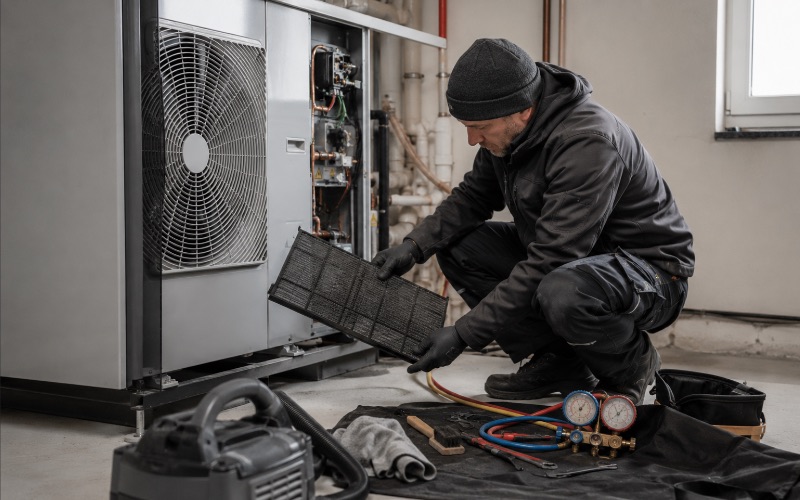
Heat pump maintenance
Preventive upkeep — filters, refrigerant, pressure and electrical connections.
Heat pump service
Technical support, settings and consultations, as well as problem diagnostics.
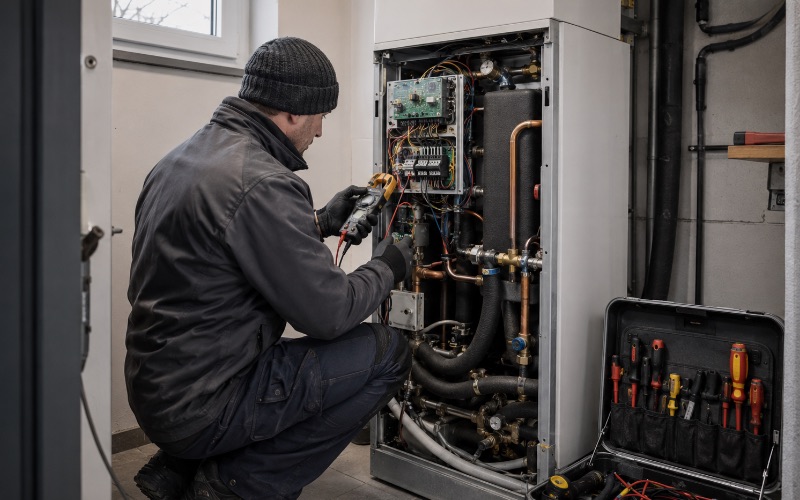
Heat pump error codes
The most common error codes and their meaning — what to do if your unit shows an error.
Heat pump not working?
Request a repair — we'll be in touch within 5 minutes!